Conditions
Cervical Spine Disc Prosthesis


The seven uppermost vertebrae of the spine (C1 to C7) form the cervical spine, which begins at the base of the skull and continues into the thoracic spine. They protect the spinal cord and support the skull.
Intervertebral discs absorb physical load and allow the vertebrae to move. Each intervertebral disc has a strong outer (fibrous) ring and a soft inner core. Problems with intervertebral discs can be caused by sudden or prolonged everyday overload, or by trauma.
When the spine is healthy, the vertebrae and intervertebral discs of the cervical spine allow the following movements:
- lateral bending (side bending);
- bending forward / backward (flexion and extension);
- turning to the right and left (rotation).
What are degenerative changes in the cervical spine?
Degenerative changes in the cervical spine are a normal part of the aging process of the spine. These changes are not always associated with pain or a reduction in quality of life. Degenerative changes in the intervertebral discs are observed in approximately 37% of people at age 20, approximately 80% at age 50, and approximately 98% of people over the age of 80.
The onset and progression of degenerative changes in the intervertebral discs can be accelerated by, for example, physical overload or prolonged monotonous body postures (working in forced positions with the head bent forward or backward), and this can cause damage to the intervertebral discs, which may lead to compression of one or more nerve roots and pain / sensory disturbances (tingling) in one or both arms.
Disc degeneration can lead to the following consequences:
- Disc herniation, which can cause compression of a nerve root and pain, tingling, or weakness in the arm (radiculopathy).
- Narrowing of the intervertebral foramen, or foraminal stenosis, whose symptoms are similar to those of disc herniation.
- Narrowing of the spinal canal (spinal stenosis), which affects the spinal cord or causes spinal cord compression (myelopathy). Spinal cord compression in the cervical spine, or cervical myelopathy, can cause sensory or motor disturbances in all extremities.
What is the Prodisc C Vivo cervical intervertebral disc prosthesis?
Prodisc C Vivo is an artificial disc designed to replace discs in the cervical spine. It consists of two titanium-alloy plates - an upper and a lower one - together with a ball-and-socket joint mechanism between them. The lower plate has a rigidly fixed special medical-grade ultra-high-molecular-weight polyethylene (UHMWPE) insert, which forms the “ball” of the joint, while the upper plate contains a mating cobalt-chromium-molybdenum (CoCrMo) alloy “socket” (dome). Movement therefore occurs at a single, precisely defined ball-joint point between these two parts - unlike prostheses with a freely moving, three-part (mobile) design, in which the polyethylene insert can independently slide and rotate between the two plates.
The plate surfaces that contact the vertebral body have a pure titanium coating and sharp projections (spikes), which provide the implant's initial (primary) stability immediately after surgery and allow the bone to gradually grow onto the implant surface over time (secondary stability).
Prodisc C Vivo is available in 18 different sizes - six width/length variants and three heights (5, 6, and 7 mm). Your doctor will select the size most suitable for you.
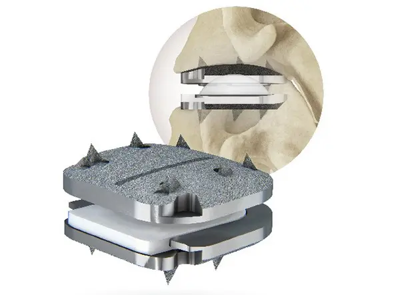
Image: Prodisc C Vivo cervical disc prosthesis.
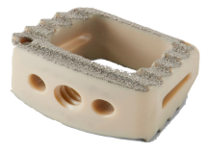
Image: Rigid cervical intervertebral implant (cage).
How does the Prodisc C Vivo intervertebral disc prosthesis move?
Movement of the Prodisc C Vivo prosthesis takes place in the ball joint between the dome of the upper plate (the round, curved cap portion) and the polyethylene insert fixed in the lower plate. The centre of rotation of this joint is located close to the lower vertebral endplate, which is close to the natural centre of motion of the intervertebral disc. The neck muscles and soft tissues move the vertebrae and the Prodisc C Vivo plates attached to them, providing a physiological (natural) range of motion - bending forward/backward (flexion/extension), lateral bending, and turning (rotation). Unlike fixed implants made of special medical plastic (PEEK) or titanium (3D-printed), or the patient's own bone (used extremely rarely today), which promote fusion of the vertebrae and immobilize (render motionless) the motion segment between two adjacent vertebrae, the Prodisc C Vivo artificial disc prosthesis provides normal, natural movement in the cervical spine.
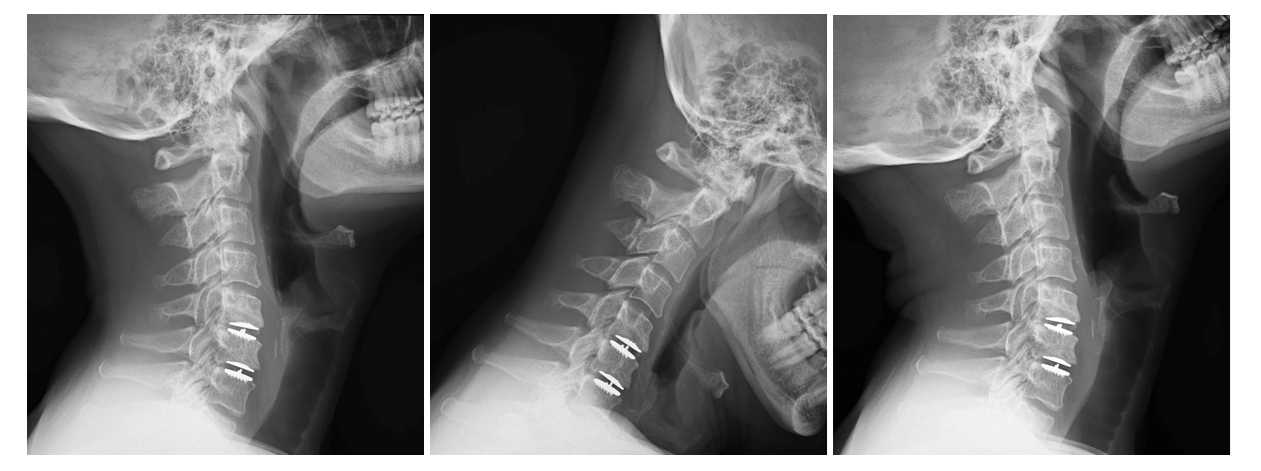 Images (left to right): Lateral radiographs (at rest, in flexion, and in extension) of a patient 1 year after anterior discectomy and disc prosthesis implantation surgery at C5/6 and C6/7.
What is ADR or TDR surgery, or cervical disc replacement with a disc prosthesis?
Prodisc C Vivo is implanted using an open anterior approach (on the front surface of the neck, most often on the right side) after discectomy, i.e., removal of the disc. This surgery is abbreviated as ADR (artificial disc replacement) or TDR (total disc replacement), i.e., replacement of the disc with an artificial disc prosthesis. More than 300,000 Prodisc C Vivo implantation surgeries have been performed worldwide, and more than 590 scientific articles have been published on Prodisc C Vivo.
In which cases is the Prodisc C Vivo intervertebral disc prosthesis recommended?
- In cases of damage to one or two intervertebral discs between C3 and C7.
- In younger patients up to 55–60 years of age.
- If the patient has symptomatic cervical disc disease - neck and/or arm pain (radicular pain) and/or functional neurological disturbances.
- Disc herniation, spondylosis (presence of osteophytes), or reduced intervertebral disc height confirmed by imaging (magnetic resonance imaging), with or without signs of radiculopathy and/or myelopathy.
- The patient has undergone at least six weeks of unsuccessful non-surgical (conservative) treatment.
In which patients must the Prodisc C Vivo intervertebral disc prosthesis not be implanted? What are the contraindications for ADR surgery?
If any of the following conditions is diagnosed, Prodisc C Vivo MUST NOT be implanted:
- fractures, infection, or tumor in the affected cervical spine segment;
- narrowing of the spinal canal (spinal stenosis) due to hypertrophic facet joint arthrosis;
- pronounced facet joint degeneration;
- increased segmental instability of the vertebrae;
- ossification of the posterior longitudinal ligament (OPLL);
- osteoporosis or pronounced osteopenia;
- acute or chronic systemic, spinal, or local infection;
- rheumatological diseases, such as ankylosing spondylitis and rheumatoid arthritis;
- any other medical or surgical condition that makes the benefit of spinal surgery questionable;
- known hypersensitivity to implant materials (titanium, cobalt, chromium, molybdenum, polyethylene);
- dependence on medications, or use of drugs or alcohol;
- pregnancy;
- severe obesity (body mass index over 40);
- the patient's inability or unwillingness to cooperate and follow treatment and rehabilitation instructions;
- patients whose skeleton is still growing (minors).
What complications are possible with ADR surgery using the Prodisc C Vivo disc prosthesis implant?
These operations are considered relatively safe, and clinical study data show that for most patients they provide pain relief and improved quality of life. For example, one of the largest randomized studies concluded that neurological status had improved in 88% of patients after surgery. However, as with any other cervical spine surgery, complications can also occur with the Prodisc C Vivo intervertebral disc prosthesis. Most of the risks of ADR surgery are similar to the risks of anterior cervical discectomy and fusion (ACDF).
- pain after surgery, pain in the shoulders, nape of the neck, and back of the head (Arnold's neuralgia, occipital neuralgia);
- temporary or permanent neck stiffness after surgery;
- ineffectiveness of the surgery in relieving symptoms, loss of range of motion in the operated segment;
- superficial or deep infections, sepsis;
- pneumonia, respiratory tract infection;
- blood clot (thrombosis) in the bloodstream or pulmonary embolism, cardiac arrest;
- reaction to medications or anesthetic agents during or after surgery, allergic or tissue reactions to implant materials;
- poor wound/tissue healing;
- post-operative hematomas, blood loss;
- rarely - myocardial infarction, stroke, or death related to the performance of the surgery;
- temporary esophageal irritation, difficult/painful swallowing;
- esophageal injury;
- recurrent laryngeal nerve paralysis, hoarseness;
- injury to the dura mater with cerebrospinal fluid leakage;
- injury to nerve roots or the spinal cord: weakness in the arm, numbness, disturbances of bowel, bladder, or sexual function;
- injury to blood vessels or surrounding soft tissues;
- bending, wear, loosening, or fracture of implant components;
- error in determining the surgical level and insertion of the implant between the wrong adjacent vertebrae;
- loss of implant fixation, displacement or migration of components (shifting), sinking of the implant into the vertebral body (subsidence);
- fracture of the vertebral body;
- changes in sagittal spinal balance;
- periarticular ossification (heterotopic ossification) and spontaneous fusion around the prosthesis;
- degenerative changes in the operated or adjacent segments, which may create the need for a repeat operation;
There may be a need to perform a repeat operation due to the above-mentioned complications.
According to data summarized in the literature, the rate of repeat surgery due to adjacent segment disease within 10 years after cervical disc replacement (with various implants) is 3.7 to 5.1% of patients, whereas after ACDF surgery it is approximately 22% of patients. This means that for disc replacement surgery, this risk is approximately four times lower.
What is the difference between the Prodisc C Vivo intervertebral disc prosthesis and ACDF surgery with insertion of a fixed intervertebral implant?
Instead of an artificial intervertebral disc prosthesis, patients often undergo anterior discectomy with insertion of a rigid intervertebral implant, or cage, i.e., fusion (ACDF). During ACDF, or anterior cervical discectomy and fusion surgery, the surgeon removes the damaged intervertebral disc and fills the disc space with a rigid plastic (PEEK), titanium, or (rarely) bone implant. The height of the implant is chosen based on the height of the disc above and below it. By restoring disc height, it is possible to reduce pressure on the nerves and/or spinal cord.
During ACDF surgery, a plate may also be screwed on from the front to additionally fix the adjacent vertebrae.
In contrast, when the intervertebral disc is replaced with the Prodisc C Vivo prosthesis, no mutual fixation of the vertebrae is performed, because the goal of the surgery is to preserve normal movement between the vertebrae of the cervical spine. Studies have shown that preserving normal movement plays an important role in the progression of degenerative (aging/wear) changes in the adjacent (above or below) disc and in the future need for an additional operation.
Both ACDF surgery and ADR surgery with the Prodisc C Vivo intervertebral disc prosthesis:
- relieve compression of the nerve roots and spinal cord;
- replace the damaged intervertebral disc;
- restore the height of the intervertebral disc space.
The Prodisc C Vivo cervical disc prosthesis, unlike a fixed intervertebral disc implant:
- ensures the preservation of normal physiological movement in the cervical spine, and
- significantly reduces the risk of damage to the discs above and below, and thus the risk of possible future surgery.