Conditions
Cervical disc herniation


What is a cervical disc herniation?
Cervical disc herniation is closely related to the anatomy of the cervical spine. The cervical spine consists of vertebrae and intervertebral discs spaced between them. The intervertebral discs consist of a dense outer ring and a thick gel-like core or nucleus. The discs provide spinal cushioning and permit the range of motion required to facilitate movement.
If the disc is deformed or the nucleus herniates, the spinal cord or any adjacent nerves can become compressed. This type of cervical disc deformation can be caused by physical loading or trauma. It can also occur as a process of natural wear and tear that the cervical disc suffers throughout its lifetime.
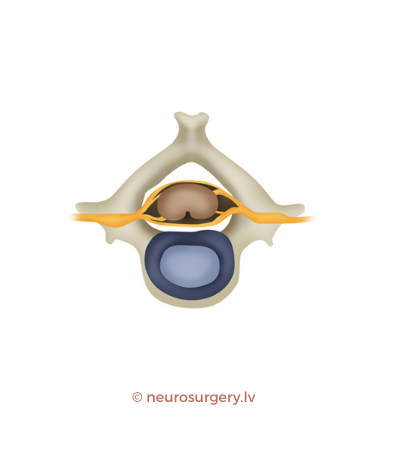
Picture: A healthy intervertebral disc in the cervical spine
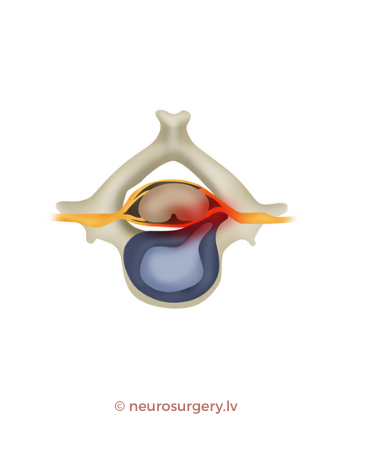
Picture: Cervical disc herniation with impingement of the exiting nerve
How does a disc herniation of the cervical spine manifest?
Each nerve that comes out of the cervical spine has its own specific area that it innervates (these areas are called dermatomes).
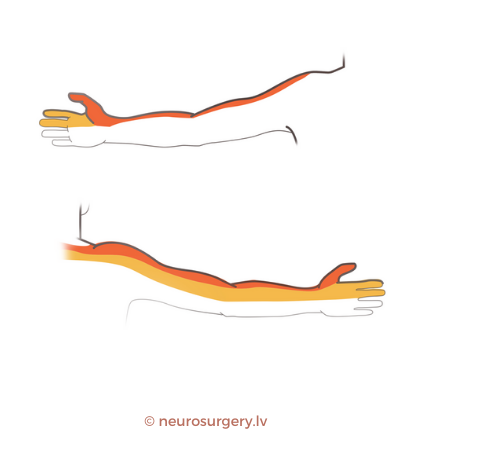
When a disc herniates and compresses a nerve it can cause pain in the corresponding dermatome (see picture).The pain is often described as pulling, sometimes burning, radiating from the neck along the path of the nerve. When it affects the arm, it is referred to as brachialgia.
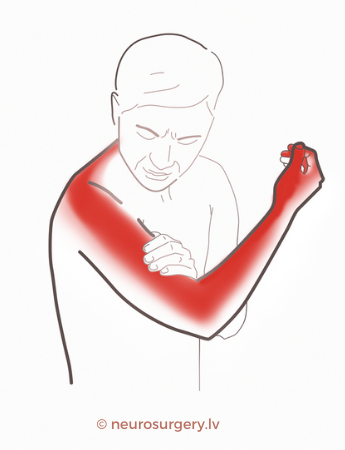
Picture: Spread of pain to the arm in the case of a cervical disc herniation (also called brachialgia)
How is the intervertebral disc herniation in the cervical spine diagnosed?
If the patient has relevant complaints and symptoms, a magnetic resonance imaging of the cervical spine should be performed to confirm the diagnosis.
How is a cervical spine disc herniation treated?
In the case of a cervical disc herniation, treatment is typically started with pain-relieving medication, as well as specific therapeutic exercises to strengthen the cervical spine. These targeted exercises strengthen the musculature of the cervical spine and relieve the pressure exerted on the intervertebral discs; this decreasing pressure promotes healing and resorption of herniated tissue, which in turn decreases the pressure on the affected nerve. About 70-80% of patients recover within 6-8 weeks of starting proper conservative treatment. If non-operative methods prove ineffective, cervical spine surgery may be considered.
When is a cervical spine disc herniation operation required?
Spinal disc hernia surgery (such as ACDF surgery) is recommended only after all non-surgical conservative treatment options have been exhausted. If drug therapy fails to alleviate pain, or if the pain is very severe from the outset of the disease, as well as if there is a loss of muscle strength and/or control, cervical spine surgery should be considered immediately.
If there is a need for our spine specialist opinion, we are happy to help. We provide appointments and consultations for both local residents of Latvia and international patients from abroad, including remote appointments via video-call. There are a number of ways to schedule an appointment with one of our specialists - electronically for Latvian residents or by requesting a remote video consultation via email or telephone contact.
What does cervical spine surgery mean to me as a patient?
With modern tools and equipment, cervical disc herniation surgery is patient-friendly and easily tolerated.
The operation involves a small incision on the skin on the anterior surface of the neck. The surgeon then creates access to the damaged vertebral disc of the spine, gradually detaching the surrounding tissue. An x-ray machine is used to verify that the correct vertebral space is being accessed. The damaged disc tissue is removed under microscope guidance and a titanium implant is inserted in its place. The operation wound is then carefully closed.
When the patient wakes up, the radiating pain in the arm is usually gone and the patient may stand up just hours after the operation and go home the very next day after surgery.
We provide world-class neurosurgical treatment for Latvian residents and for international patients. Learn more here if you are an international patient considering having treatment with us.
The venue for surgical interventions is a perfectly equipped and comfortable private hospital in Riga – “Aiwa Clinic”.
How effective is the operation?
Cervical disc herniation surgery is highly effective – about 90% of patients are able to completely get rid of their arm pain.
In case you are considering having surgery with us, you can learn more about the experience of our international and Latvian patients by checking our patient testimonials page.
Does cervical spine surgery carry high risks?
In general, anterior cervical discectomy and fusion (ACDF) surgery is considered safe, but as with any surgical procedure, there are some potential risks that your doctor will discuss with you if surgery becomes necessary.