Conditions
Lumbar disc herniation


Lumbar disc herniation
What causes disc herniation in the lumbar region?
Lumbar disc herniation (commonly known as a slipped disc) is closely related to the structure of your lower back. The intervertebral disc consists of two parts – a dense circular ring containing a thick, gel-like core. These spinal discs are essential structures functioning as shock absorbers that provide cushioning between the vertebrae. They are integral for maintaining posture, permitting a wide range of movement, and providing vital support to the adjacent vertebrae of the spine.
A lumbar disc herniation occurs when the protective outer ring of the intervertebral disc ruptures, allowing the soft inner core to protrude outward. Herniated disc symptoms develop when this protruding tissue comes into contact with or presses against an adjacent spinal nerve, often resulting in a pinched nerve. Because nerves in the lumbar spine descend into the lower extremities, discomfort is typically felt along the path of the affected nerve (frequently causing leg pain, numbness, or sciatica). However, if the herniation occurs in a direction that does not touch any spinal nerves, a lumbar disc herniation can remain completely asymptomatic.
A disc protrusion is a common finding on radiological examinations. Unlike a disc herniation, where the outer ring is torn, a disc protrusion preserves the structural integrity of the disc itself, which is instead bulged, deformed, or displaced. Small, minor disc protrusions are frequently detected on magnetic resonance imaging (MRI) or computed tomography (CT) scans and seldom cause symptoms. However, it is possible for a disc protrusion to grow large enough to compress an adjacent spinal nerve, triggering noticeable nerve compression symptoms.
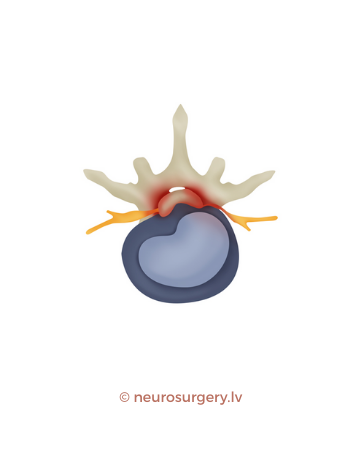
Picture: Massive lumbar disc herniation
What are the factors that increase the risk of developing a disc herniation?
Intervertebral disc herniation is a common spinal condition that primarily affects individuals between the ages of 25 and 50. Men develop this condition approximately twice as often as women. Heavy physical labor significantly increases the risk of both initial disc herniation and its recurrence. Furthermore, excess body weight substantially elevates the risk of developing a herniated disc and its recurrence—increasing the risk of re-herniation nearly 12-fold in patients who have undergone a microdiscectomy procedure.
Smoking (nicotine) reduces blood flow to the intervertebral disc, contributing to accelerated disc degeneration (the deterioration of cellular functions) and significantly delaying the natural healing process.
Of course, a lumbar disc herniation can occur in anyone at any age, even without an obvious underlying cause.
While symptoms of a herniated disc often appear without a clear trigger, they are frequently linked to heavy lifting, sudden twisting, pushing, or pulling. As load and pressure on the spine increase—particularly in individuals with weak postural muscles—the intervertebral disc may tear or rupture. This can irritate or compress the adjacent spinal nerve root, resulting in severe shooting pain through the buttocks and leg, commonly known as sciatica.
What are the symptoms of lumbar disc herniation?
- Leg pain (radicular leg pain / sciatica): This pain is typically significantly more severe than back pain. It is often described as a sharp, shooting, burning, or persistent pain radiating down the leg.
- Lower back pain: Frequently encountered in the early stages of a herniated disc. When present, back pain is usually much less intense than the radiating leg pain.
- Tingling and numbness: Numbness or a "pins and needles" sensation in the leg or foot. This is most commonly felt in one leg, though occasionally observed in both.
- Localized pain distribution: The exact location of pain and numbness depends on which lumbar spine level (vertebrae) is affected. Symptoms may manifest in the buttocks, front or back of the thigh, lower leg, or foot.
- Pain provoked by movement: Symptoms often worsen after prolonged sitting, standing, or walking short distances. Sudden spinal pressure from coughing, sneezing, or laughing can trigger sharp pain spikes.
- Muscle weakness (Red Flag Symptom): Progressive muscle weakness in the leg or foot (such as foot drop) is a critical warning sign indicating severe spinal nerve compression that requires prompt medical evaluation.
- Cauda Equina Syndrome (Emergency Symptom): Loss of bowel or bladder control (incontinence or retention), saddle anesthesia (numbness in the groin and inner thighs), and weakness in both legs are rare (1% to 2% of surgical cases) but severe medical emergencies caused by Cauda Equina compression. In cases of major disc herniations presenting with Cauda Equina Syndrome, there is an elevated risk (approximately 45%) that even after successful surgical decompression, some urinary, bowel, or sexual dysfunction may persist.
What examinations are needed?
If you experience any of the symptoms described above, you should consult a doctor or spine specialist promptly. A detailed patient history and comprehensive neurological examination are often sufficient to pinpoint the exact level of the nerve compression. This allows diagnostic imaging, such as a spinal MRI or CT scan, to precisely target the affected area. Diagnostic imaging is equally essential for younger patients with normal body weight who present with a suspected herniated disc. A timely consultation with a neurosurgeon saves valuable time, avoids unnecessary tests, and provides clear guidance regarding your diagnosis and personalized treatment options.
If you require a specialist second opinion or expert medical evaluation, our team is happy to help. We offer both in-person and remote consultations for local residents as well as international patients seeking treatment abroad. Scheduling an appointment with one of our neurosurgeons is quick and straightforward - you can book electronically online (for residents of Latvia) or request a remote video call consultation via email or phone.
What are the treatment options?
Treatment options are thoroughly discussed and decided upon in close consultation with your spine specialist. If your symptoms, neurological evaluation, and radiological findings indicate that non-operative care is appropriate, your doctor will outline your personalized conservative treatment plan, adjust it as needed, and schedule your follow-up visits. In cases of severe pain, targeted interventional options—such as epidural steroid injections—may be recommended to reduce inflammation and provide effective pain relief.
When is lumbar disc herniation surgery recommended?
For patients presenting with a symptomatic lumbar disc herniation, surgery is required in only 10% to 20% of cases.
An elective spine operation is considered if:
Severe pain and neurological symptoms persist after at least 6 weeks of comprehensive conservative treatment.
Urgent or semi-urgent decompression surgery is required if:
- The patient suffers from severe, debilitating pain that cannot be alleviated by medication or nerve block injections, severely restricting daily mobility such as walking or standing;
- Neurological deficits (such as progressive leg weakness or increasing numbness) continue to worsen;
- Emergency symptoms develop, including urinary or bowel incontinence, saddle anesthesia, or sudden sexual dysfunction (indicating Cauda Equina Syndrome).
What does surgery involve for a lumbar disc herniation?
The most common operation for a lumbar disc herniation is a minimally invasive microdiscectomy, performed through a small 2.5–3 cm incision. Intraoperative X-ray guidance is used before and during the procedure to ensure maximum precision and patient safety. Performed under high-power microscope control, the herniated disc fragments are carefully removed to decompress the affected nerve. Because the intervertebral disc is a vital structural element of the spine, the primary objective of this surgery is to remove the herniation while preserving as much healthy disc tissue as possible.
Most patients spend only one night in the hospital following surgery. The next morning, a physiotherapist assists with early mobilization and initial rehabilitation exercises prior to discharge. Most patients can expect to resume normal daily activities and return to work within 3 to 4 weeks post-surgery.
We provide world-class neurosurgical care for both Latvian residents and international patients. If you are an international patient considering treatment abroad, explore our specialized international patient services.
The venue for surgical interventions is perfectly equipped private hospital in Riga – “Aiwa clinic”.
What post-operative regimen should I follow after disc herniation surgery?
Because the highest pressure on the spinal disc occurs when sitting, bending forward, or lifting heavy objects, following a strict post-operative care regimen for 3 to 4 weeks after surgery is essential to prevent recurrent disc herniation:
- Avoid sitting: Minimize sitting positions as much as possible during initial recovery. You are encouraged to stand, walk, and lie down, but prolonged sitting must be avoided. Even getting out of bed should be done carefully to avoid sitting straight up. A physiotherapist will guide you on safe bed-mobility techniques and early rehabilitation exercises starting the first day after surgery.
- Avoid bending forward: Flexing the spine forward increases intradiscal pressure, raising the risk of re-herniation. Your physiotherapist will teach you proper movement mechanics to safely retrieve objects without bending at the waist.
- Avoid heavy lifting: Lifting heavy objects puts substantial stress on the healing intervertebral disc and must be strictly avoided during early recovery.
- Avoid body twisting: Rotational movements (twisting the torso) strain the recovering disc and should be completely avoided.
What are the results of lumbar disc herniation surgery?
Microdiscectomy is a highly effective procedure, yielding good to excellent outcomes in 84% to 90% of cases. The primary goal of surgery is the complete relief or significant reduction of neurological symptoms, including radicular leg pain (sciatica), numbness, and muscle weakness. It is important to note that microdiscectomy is designed to decompress pinched nerves rather than treat axial low back pain alone, and it is generally not indicated if back pain is the primary complaint.
While lumbar microdiscectomy is considered a safe, low-risk procedure, all surgical interventions carry inherent risks. Recurrent disc herniation at the same level is the most common complication, occurring most frequently within the first three months post-surgery. Strictly adhering to the post-operative instructions provided by your neurosurgeon and physiotherapist is essential to minimize the risk of recurrence.
If you are considering spine surgery with our clinic, you can explore the experiences and reviews of our local and international patients on our patient testimonials page.